

The Open House Yard Sign Strategy That Gets Buyers to the Door
Open house yard signs are temporary directional signs placed before and during an open house to guide visitors to the property. Most setups include two components: directional signs staked at every significant turn between the main road and the house, and a main property sign at the listing itself confirming arrival. Together they function as a wayfinding system for buyers driving through an unfamiliar neighborhood trying to find a specific address.
That system has one day to get the job done. A listing sign goes up at the curb and builds passive awareness over weeks. An open house sign has to move a stranger from a busy road to a specific front door without a single wrong turn. One sign staked in the front yard is not enough.
This guide covers how to build a sign chain, design rules that hold up for drivers at speed, placement decisions that cost agents foot traffic, timing and compliance basics, and how to build a sign kit that pays off across a full season.
For sign strategy across every listing stage, from coming soon through sold, the full realtor yard sign strategy guide covers how open house signs fit your broader marketing system.
How an Open House Sign Chain Works
The goal of an open house sign system is to guide a stranger from the nearest major road to the front door without a single wrong turn. Most agents build this backward, starting at the property and working outward. The right direction is the reverse.
Start at the Main Road, Not the Property
The first sign in the chain anchors at the nearest major intersection or arterial road — not at the property. Drive the route from that intersection to the property and mark every point where a buyer could take a wrong turn. That list is your sign chain. Each point on it gets a sign.
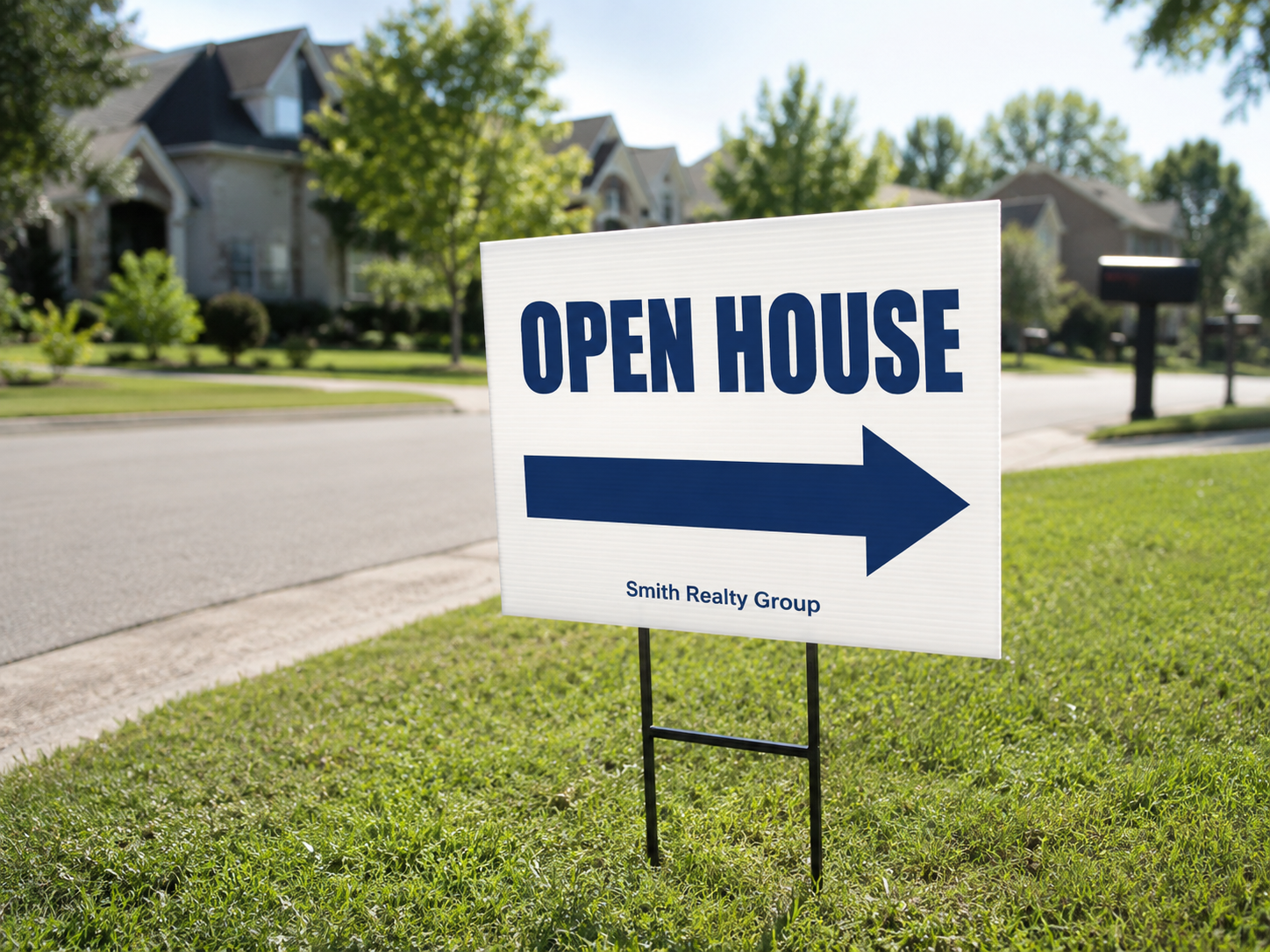
Where permitted, begin the sign chain at the nearest major intersection or the earliest legal placement point along the primary route.
What Each Point in the Chain Should Do
A sign chain has four waypoint types, each with a different job:
- Main road signs create awareness and give an initial direction.
- Subdivision entrance signs confirm the buyer turned correctly.
- Interior turn signs cover every decision point inside the neighborhood.
- The property sign confirms arrival and carries the full address.
The property sign can function as a for sale yard sign in some cases with open house details added. FSBO sellers who need both a listing sign and directionals should treat these as a coordinated set. At gated entrances or long driveways where staking is not practical, custom open house flags are a high-visibility alternative that stays readable from a moving vehicle.
How Many Open House Signs Do You Actually Need?
The right number depends on neighborhood layout, not a formula. A three-turn suburban grid needs a different count than a winding cul-de-sac where a buyer can make four wrong turns inside a half mile.
|
Neighborhood type |
Recommended count |
Logic |
|
Suburban grid |
8–12 |
Cover 2–3 major turns from main road |
|
Winding / cul-de-sac |
12–15 |
More turns, more dropout points |
|
Rural or semi-rural |
15+ |
Greater distance between turns |
|
Urban / foot traffic primary |
5–8 |
Shorter distances, fewer vehicles |
Drive the route before placing signs. If you run short on the day, cover the turns closest to the property first.
Open House Sign Design Rules for Drivers
A driver at 35 mph has about four seconds to see a sign, read it, and decide what to do. Every design decision should be tested against that constraint.
What Goes on a Directional Sign (and What Doesn't)
Directional open house signs need three elements: "OPEN HOUSE" in large dominant text, a clear directional arrow, and nothing else competing for attention. The address belongs on the property sign, not on every directional along the route. Agent name, photo, and brokerage go at the bottom in a smaller font. A buyer following a sign chain does not need your credentials at that moment. They need to know where to turn.
Skip the QR code on directional signs. At curb speed, no one scans a code they pass at 35 mph. QR codes belong on the property sign only, where visitors are already slowing down and on foot.
Color and Contrast at Curb Speed
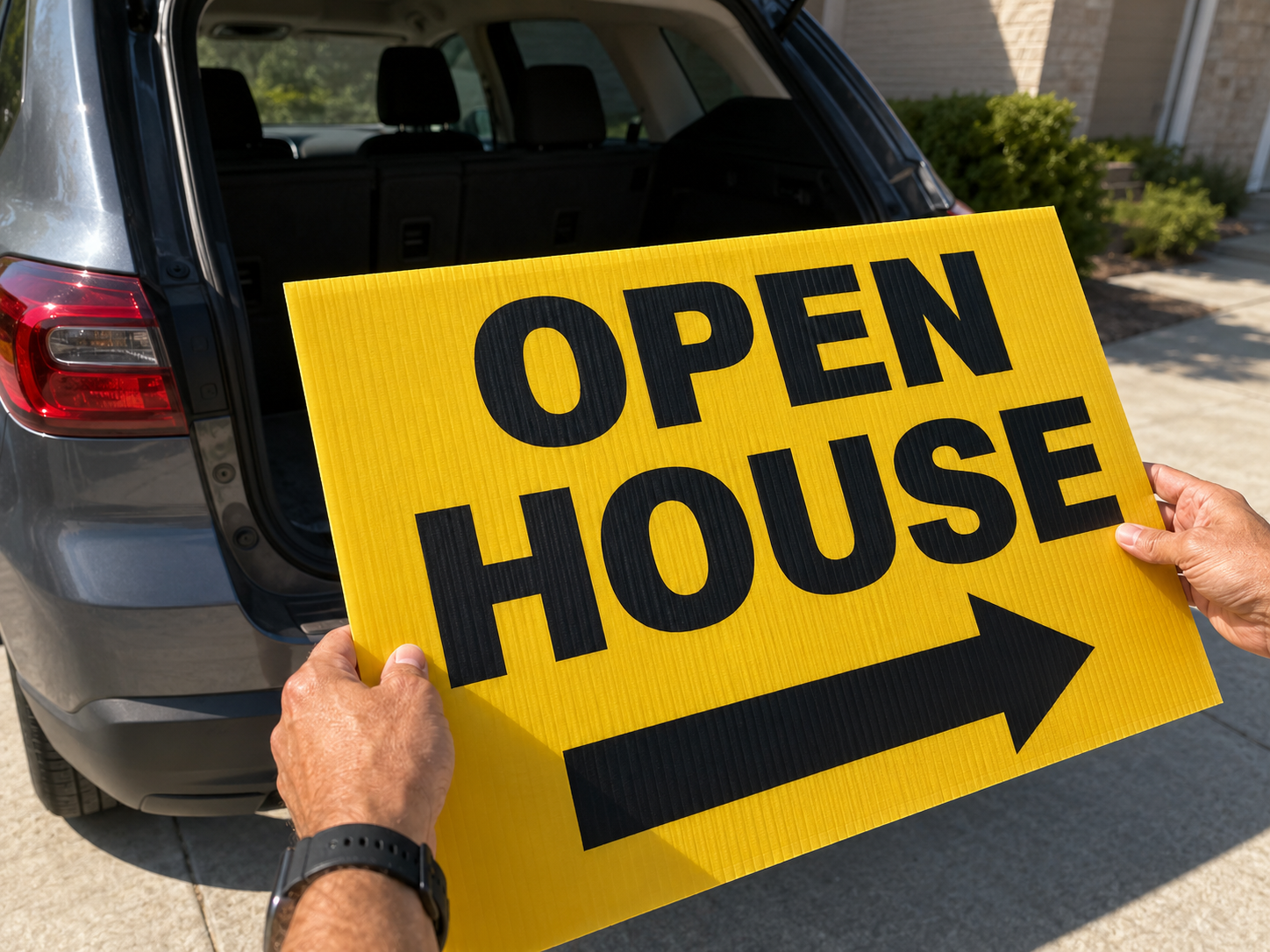
High contrast is a legibility requirement, not a style preference. Navy on white, red on white, and black on yellow hold up at distance from a moving vehicle. Gradient backgrounds and low-contrast color pairings fail before the buyer is close enough to read anything.
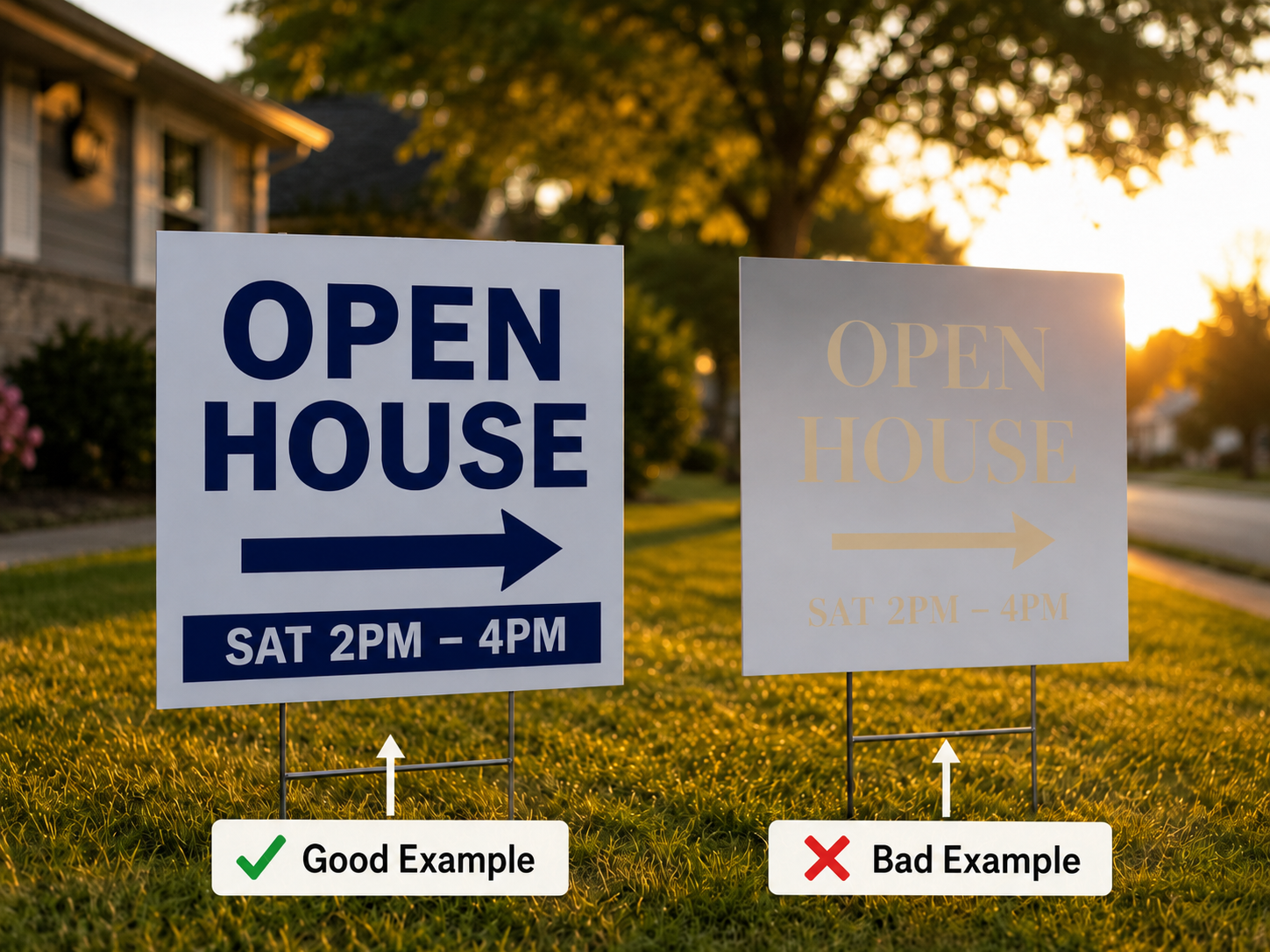
For guidance on which color combinations perform best across different light conditions, the guide to the best colors for yard signs covers the options that work for open house signage.
Fonts That Work From the Street
Thick, bold sans-serif fonts are the only right choice for directional signs. Scripts and decorative fonts that look sharp in a design file become unreadable at curb speed. Letter spacing matters too. Tight tracking compresses legibility at distance.
For specific font recommendations that hold up for real estate yard signs, the guide to the best fonts for yard signs covers what agents use most.
Riders vs. Reprinting: Which to Use When
For agents who want a reusable sign system, custom open house sign riders solve the date and time problem without reprinting the full directional base. A rider is a smaller panel that attaches above or below the main sign frame and carries one piece of event-specific information — typically "Today 1–4 PM" or "Sunday 12–3 PM." The base sign stays the same across every event. Only the rider changes.
Reprinting a full sign to update a date wastes budget and creates variation across your sign kit. Riders are the right tool for any agent running more than a handful of open houses a year.
Placement Decisions That Lose Buyers
Getting the sign in the right position matters as much as the design. Two placement errors account for most of the foot traffic lost at open houses.
Sign Angle and Curb Setback
The most common placement mistake is angling the property sign toward the front door. From the sidewalk it looks centered. From a car, it is nearly invisible. Every sign in the chain should face perpendicular to the street so the face reads clearly to oncoming traffic.
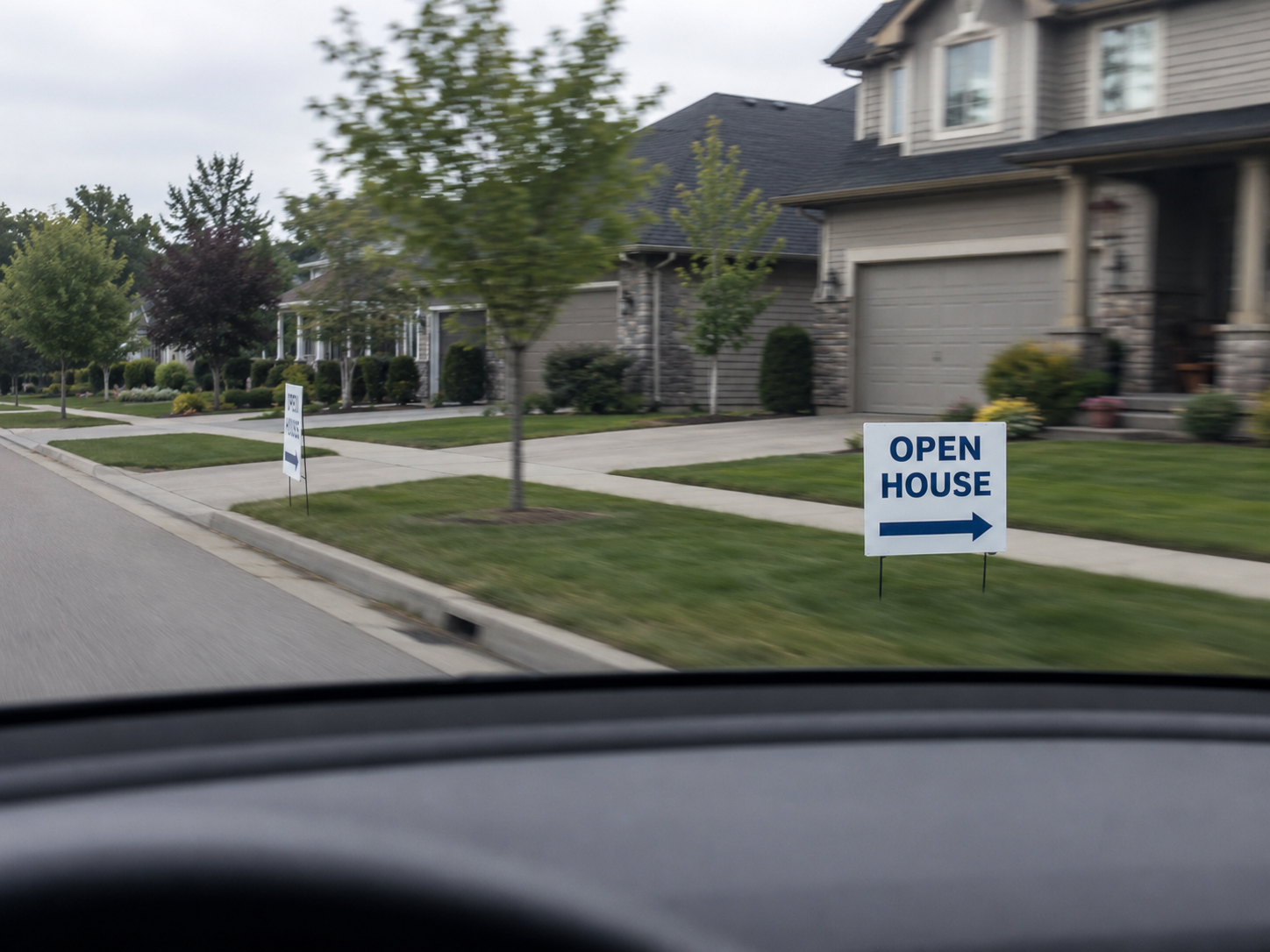
Curb setback is the second variable. At 35 mph, a driver needs time to see the sign, read it, and react before passing the turn. Pulling signs 8 to 10 feet back from the curb edge, where the yard allows, gives buyers more time to process what they are seeing. On streets without a clear curb, align the sign with the edge of the traveled surface.
HOA and Gated Community Workarounds
HOA-restricted neighborhoods limit open house sign placement at the entrance and sometimes inside the community. The answer is not fewer signs. It is repositioned signs.
Place directional signs on public right-of-way just outside the gate, before the HOA-controlled area begins. Inside the community, rely on the property sign to carry more detail, including a clear address and any approach instructions that help buyers navigate. Check the CC&Rs before the listing goes active. For a breakdown of sign placement rules by municipality and neighborhood type, the yard sign placement laws and regulations guide covers what is and is not permissible.
Our custom real estate yard signs are available in sizes that comply with the most common HOA dimension restrictions.
Managing Two Sign Chains on the Same Day
Agents running two open houses simultaneously in overlapping areas risk buyers following the wrong sign chain to the wrong property. The fix is differentiation before deployment.
Use a distinct primary color for each listing's sign set. Drive both routes from the main road before the event and confirm the chains do not share any turning points. A five-minute route check the morning of the event catches most conflicts before the first buyer arrives.
Timing, Compliance, and Same-Day Cleanup
The sign that is still up when the event ends is the sign that creates a problem.
Day-of deployment is the safest default in areas with strict sign rules. Many municipalities and HOAs prohibit open house signage on public right-of-way until the actual event day, and the 24 to 48 hour window that some guides recommend can put you in violation before the open house begins.
Some agents warm up neighborhood awareness in advance by distributing custom door hangers for real estate to nearby homes one to two days before the event. That outreach does not carry the same placement restrictions as yard signs.
Pull all open house signs the same day the event ends, within an hour of the house closing. Left-up signs generate HOA complaints, invite ordinance fines, and signal disorganization to the neighborhood. The reputational cost of a sign left up overnight is larger than most agents account for.
Before placing any signage, check three things: the city right-of-way rules for that property's location, the HOA sign policy if the property is in a governed community, and the county sign ordinances. FSBO sellers are more likely to skip this step. A quick call to the local municipality before the first open house answers most questions and prevents most fines.
Building a Sign Kit for Multiple Open Houses
Agents who run open houses regularly pay more per event than necessary when they order signs each time instead of maintaining a reusable kit.
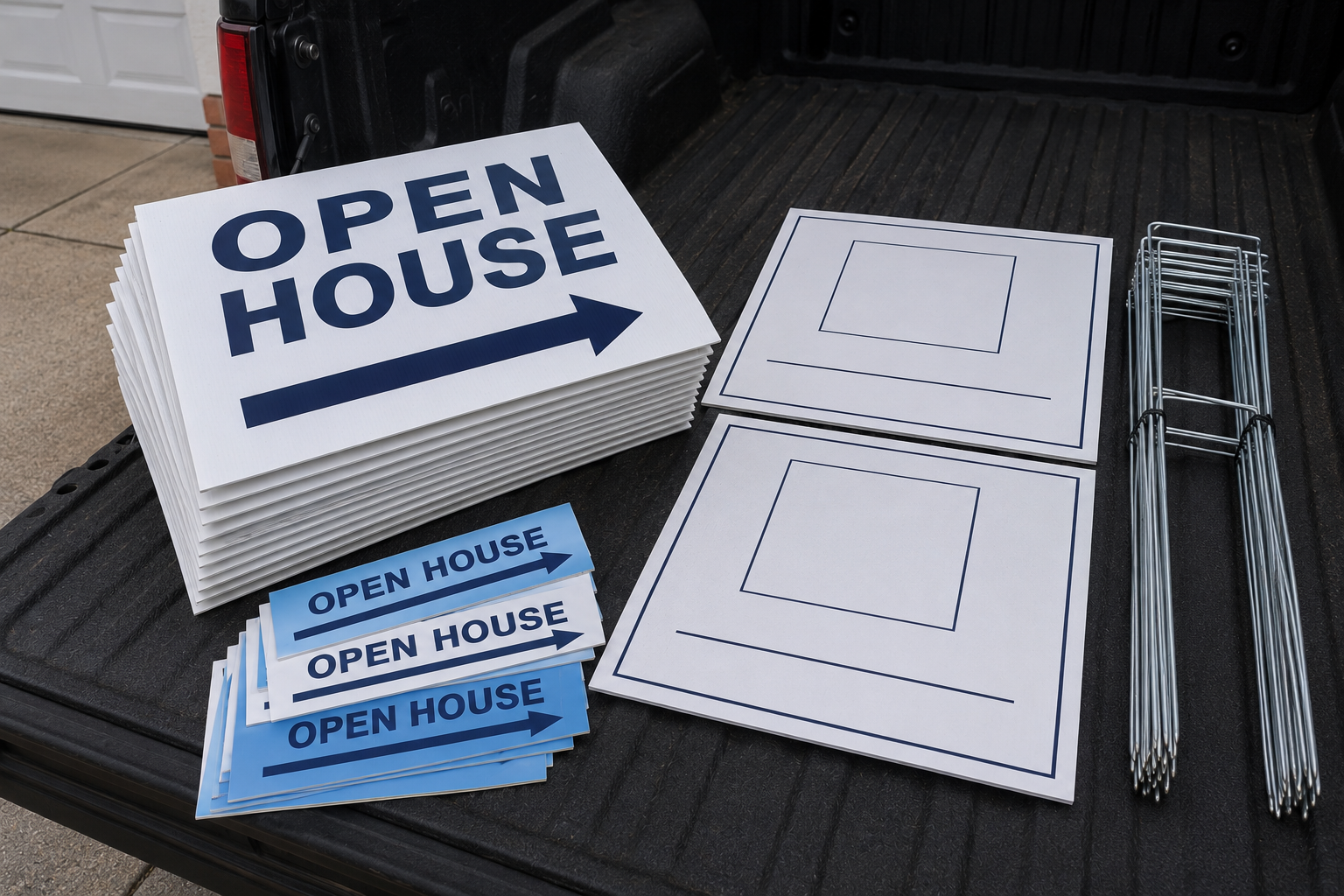
What the Kit Should Include
The base kit for most agents:
-
10 to 15 directional signs printed with "OPEN HOUSE" and an arrow, no date or property address
-
4 to 6 riders with swappable time panels
-
One to two main listing signs per active listing
-
Metal H-stakes for all directionals
Signs with no event-specific information are fully reusable across any property in any neighborhood.
Storing and Maintaining Signs Between Events
Store yard signs flat and out of direct sunlight between open houses. Before each deployment, check for UV fade, ink bleed, and stake-hole cracking. A sign that holds up in a garage may look washed out under direct afternoon sun. For H-stake selection and installation across different soil conditions, the guide to securing yard signs in the ground covers what holds and what fails.
When to Reorder
Three reorder triggers: visible UV fade, cracked stake holes, and any sign carrying listing-specific information from a closed sale. For agents building out a sign kit across multiple active listings, the bulk order program has volume pricing tiers that reduce per-sign cost on larger sets. Browse custom real estate yard signs with no minimum order and a free proof in about an hour.
Answers to Common Open House Yard Sign Questions
How many open house signs do I actually need?
Most open houses require 8 to 15 directional yard signs depending on how many turns separate the property from the nearest major road. A straightforward suburban grid needs fewer. A winding subdivision where buyers can take multiple wrong turns needs more.
Should open house directional signs be double-sided?
Yes. A double-sided sign captures drivers approaching from both directions at an intersection. Single-sided signs lose half their potential audience at every turn.
What is the most important thing to put on an open house sign?
"OPEN HOUSE" in the largest text, and a clear directional arrow. The property address belongs on the listing sign at the house, not on every directional sign along the route.
Can I place open house signs on public property or the right-of-way?
It depends on the municipality. Some allow temporary real estate signs on public right-of-way. Others prohibit them entirely. The yard sign placement laws and regulations guide covers common restrictions by location type.
How far in advance should I put up open house signs?
Day-of deployment is the safest default where local rules are uncertain. In areas without strict sign ordinances, placing signs 24 to 48 hours before gives drive-by traffic more time to register the event.
What size should open house yard signs be?
Standard directional open house signs are 18 by 24 inches. The main property sign is often 24 by 36 inches for better road visibility. Check HOA rules before ordering — some governed communities restrict sign dimensions.
Where exactly should I place open house yard signs?
At the nearest major intersection, at every turn between that road and the property, at the subdivision entrance if applicable, and at the property itself. Every point where a buyer could take a wrong turn gets a sign.
What if my open house signs keep getting moved or taken?
Bring two or three extra signs on the day of the event. Stake all directionals firmly with metal H-stakes, and walk the sign chain before buyers arrive to confirm every sign is still in position.
Do FSBO sellers need a different open house sign strategy than real estate agents?
The placement system is identical. The difference is scale. Most FSBO sellers need 5 to 8 directional yard signs plus the main property sign for a single listing. The design rules, placement logic, and compliance steps are the same regardless of who is running the event.
Order your custom open house yard signs with no minimum, no setup fees, and a free proof in about an hour. They ship the next business day from our Houston facility.


Leave a Comment